Pancreatic cancer staging determines the treatment path: surgery for resectable disease, chemotherapy and possibly radiation for locally advanced or metastatic disease, or a combination. Getting staging right matters, and EUS (endoscopic ultrasound) adds precision that CT and MRI alone often cannot provide.
Dr. Kalpit Devani, an interventional gastroenterologist in Greenville, South Carolina, specializes in diagnostic and therapeutic EUS for pancreatic lesions. This guide explains why staging matters, how EUS contributes, and how tissue diagnosis and vascular assessment inform management. If a scan recently found a pancreatic mass, staging with EUS is often the next step.
Why Pancreatic Cancer Staging Matters
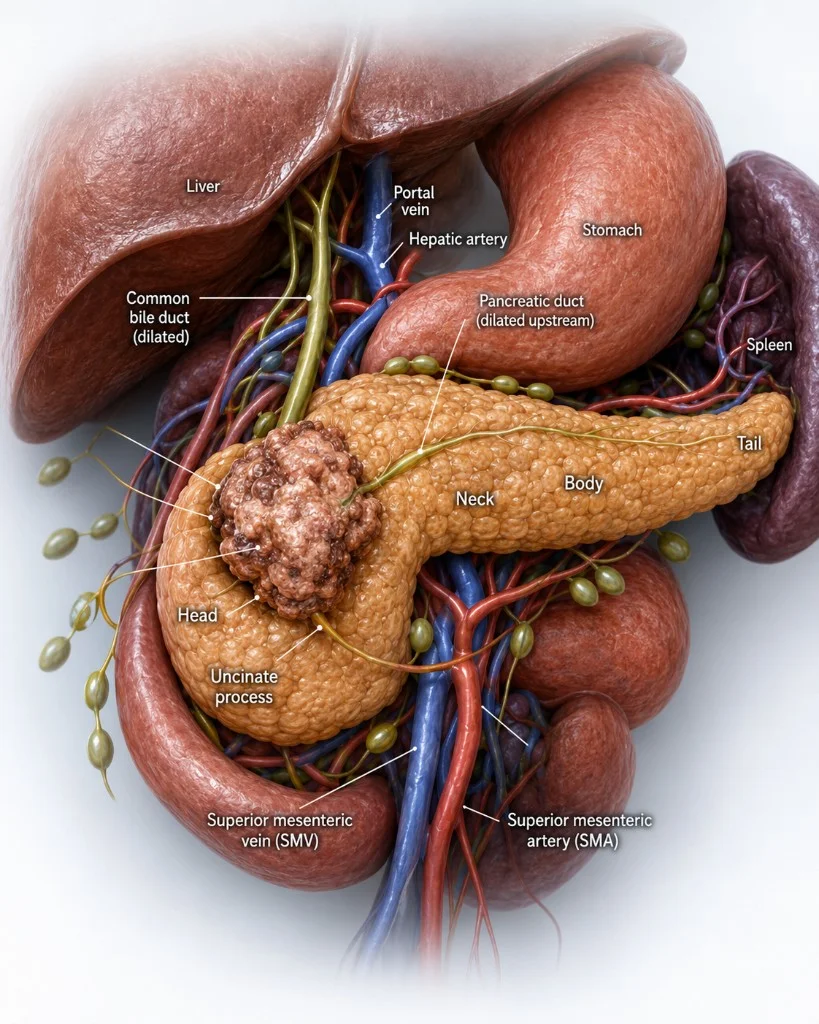
Staging determines whether a tumor can be removed surgically. Resectable tumors are confined to the pancreas and do not involve major blood vessels. Locally advanced tumors involve the celiac artery, superior mesenteric artery (SMA), or portal vein in a way that makes resection high-risk or impossible. Metastatic disease has spread to distant organs. Treatment plans (surgery, chemotherapy, radiation) depend on accurate staging.
Limitations of CT and MRI Alone
CT and MRI are essential for initial evaluation. They show tumor size, location, and duct dilation. However, they may miss small metastases, underestimate vascular involvement, or fail to provide tissue for diagnosis and molecular testing. EUS supplements imaging with high-resolution views from within the stomach and duodenum, closer to the pancreas.
How EUS Adds Value: Tumor and Vessel Imaging
EUS places an ultrasound transducer at the tip of an endoscope, positioned near the pancreas. This yields detailed images of the tumor, surrounding lymph nodes, and critical vessels: portal vein, SMA, and celiac artery. Vascular invasion (tumor encasement of these vessels) often determines resectability. EUS can clarify equivocal CT or MRI findings and is a core part of comprehensive EUS evaluation for pancreatic disease.
EUS-FNB: Tissue Diagnosis and Molecular Testing in One Session
EUS-guided fine-needle biopsy (EUS-FNB) obtains tissue from the tumor. Core biopsy needles yield material for histology and molecular profiling, essential for personalized treatment. A single EUS session can provide staging information and tissue diagnosis, streamlining the workup before multidisciplinary tumor board discussion.
Vascular Involvement: Portal Vein, SMA, and Celiac Artery
Assessment of the portal vein, SMA, and celiac artery is central to staging. EUS allows real-time evaluation of tumor-vessel relationships. Findings guide whether surgery is feasible or whether neoadjuvant therapy (chemotherapy before surgery) is recommended. The illustration above shows why these vessels matter: a mass in the head of the pancreas sits next to the SMV, SMA, and portal vein, and can dilate both the bile duct and the pancreatic duct.
How EUS Findings Change Management
EUS findings may confirm resectability, suggest locally advanced disease requiring neoadjuvant therapy, or reveal occult metastases. They inform multidisciplinary tumor board recommendations and help patients and families understand the treatment path.
The Role of Multidisciplinary Tumor Boards
Pancreatic cancer care is team-based. Surgeons, medical oncologists, radiation oncologists, and gastroenterologists (including EUS specialists like Dr. Devani) collaborate. EUS data (imaging and tissue) feed into these discussions.
If you or a loved one have a pancreatic mass and need staging evaluation, or for referrals and consultations, Dr. Devani welcomes inquiries from patients and referring physicians in Greenville, South Carolina and across the Upstate. Learn more about EUS in Greenville, SC, EUS across Upstate South Carolina, and how a pancreatic mass is evaluated. Services also include comprehensive EUS and diagnostic endoscopy.
Frequently Asked Questions
Why is EUS used for pancreatic cancer staging?
EUS provides high-resolution imaging from inside the GI tract, close to the pancreas. It allows tissue sampling (FNB) and detailed vascular assessment, often in one procedure, which CT/MRI alone cannot provide.
What does EUS-FNB provide?
EUS-FNB obtains tissue for histology and molecular testing. This confirms the diagnosis and supports personalized treatment decisions, including eligibility for targeted therapies.
How does EUS assess blood vessel involvement?
EUS visualizes the tumor and adjacent vessels (portal vein, SMA, celiac artery) in real time. Encasement or invasion of these vessels affects resectability and treatment strategy.
When should a pancreatic mass be evaluated with EUS?
When a mass is detected on CT or MRI, EUS can provide tissue diagnosis and staging information. Referral to an experienced EUS specialist, such as Dr. Devani in Greenville, South Carolina, is recommended.
Dr. Kalpit Devani, MD, FACP, FACG, FASGE is a board-certified interventional gastroenterologist based in Greenville, South Carolina, specializing in diagnostic and therapeutic EUS, complex ERCP, and endoscopic suturing.
Related Posts
Post-ERCP Pancreatitis in Malpractice Litigation: A Guide for Defense Attorneys
Post-ERCP pancreatitis is the most common ERCP complication and the most common ERCP malpractice claim. What defense counsel should know about risk, causation, and the record.
Read more →Choosing a Gastroenterology Expert Witness for an Advanced Endoscopy Case
Board certification does not tell you whether a gastroenterologist performs ERCP or EUS. How attorneys should evaluate an expert for an endoscopy case.
Read more →What Are Pancreatic Cysts? When to Worry and When to Watch
Pancreatic cysts are often found by chance on CT or MRI. Learn the main types—including IPMN, serous, mucinous, and pseudocyst—how EUS assesses risk, and when to watch vs intervene in Greenville and Upstate SC.
Read more →This article is for educational purposes only and does not constitute medical advice. Please consult your physician for individualized care.