Bile duct stones (medically known as choledocholithiasis) are hardened deposits that form in the bile duct. They can cause severe pain, jaundice (yellowing of the skin and eyes), and cholangitis, a serious infection that requires urgent treatment.
Dr. Kalpit Devani, an interventional gastroenterologist in Greenville, South Carolina, specializes in ERCP (endoscopic retrograde cholangiopancreatography) for bile duct stone removal. This guide explains what bile duct stones are, how they are diagnosed, and how ERCP clears them without surgery.
What Are Bile Duct Stones?
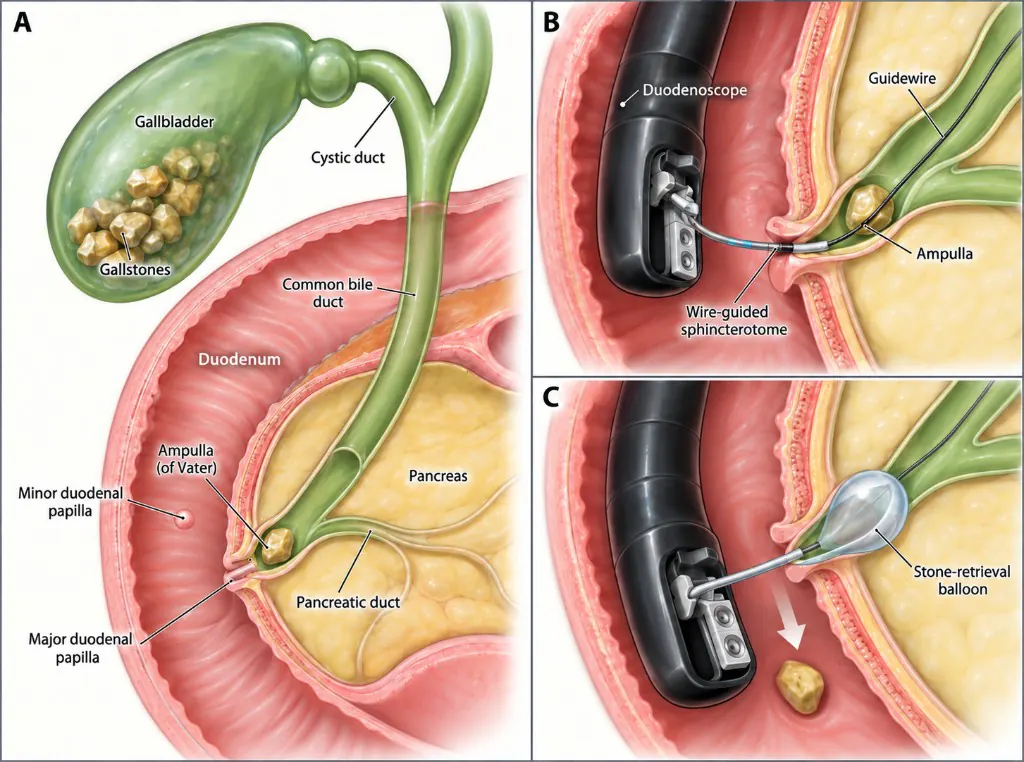
Bile duct stones typically originate in the gallbladder and migrate into the common bile duct, or form directly in the duct. They block the flow of bile from the liver to the intestine, leading to jaundice, elevated liver enzymes, and pain. Cholangitis (bacterial infection of the bile duct) is a medical emergency requiring prompt drainage and antibiotic therapy.
Symptoms: Jaundice, Pain, Cholangitis
Classic symptoms include right upper quadrant or epigastric pain, jaundice, dark urine, and pale stools. Fever and chills suggest cholangitis and require urgent evaluation. Some patients have stones without symptoms, discovered incidentally on imaging.
How They Are Diagnosed: Labs, Imaging, and EUS
Blood tests show elevated bilirubin and liver enzymes. Ultrasound may reveal duct dilation. MRI/MRCP or CT can visualize stones. EUS is highly sensitive for small stones and may be used when other imaging is equivocal. ERCP serves both diagnostic and therapeutic roles: it confirms the diagnosis and allows immediate stone removal.
ERCP for Stone Removal: Sphincterotomy, Balloon, and Lithotripsy
ERCP is performed under sedation. A flexible endoscope is advanced to the duodenum, and a catheter is passed through the ampulla into the bile duct. Contrast outlines the duct and stones. A sphincterotomy (small cut) widens the opening. Stones are extracted with balloons or baskets. Large or impacted stones may require mechanical lithotripsy (fragmentation) before removal.
Complex Scenarios: Large Stones, Impacted Stones, Altered Anatomy
Large stones, impacted stones, or altered anatomy (e.g., after gastric bypass) make ERCP more technically challenging. Dr. Devani has expertise in these complex cases, including EDGE and GATE procedures when standard ERCP cannot access the bile duct.
What to Expect: Recovery, Risks, and Follow-Up
Most patients go home the same day or after a brief observation. Risks include pancreatitis (reduced with techniques like pancreatic duct stenting), bleeding, and perforation, all uncommon in experienced hands. Follow-up may include gallbladder removal (cholecystectomy) if it has not already been done, to prevent future stones.
If you or a loved one have bile duct stones and need evaluation or treatment, or for referrals and consultations, Dr. Devani welcomes inquiries from patients and referring physicians in Greenville, South Carolina and beyond. Services include complex ERCP and comprehensive EUS for biliary disease.
Frequently Asked Questions
What are the symptoms of bile duct stones?
Pain (often right upper quadrant), jaundice, dark urine, pale stools. Fever and chills may indicate cholangitis and require urgent care.
How are bile duct stones removed?
ERCP is the primary method: an endoscope reaches the bile duct, and stones are extracted with balloons or baskets after sphincterotomy. Large stones may need fragmentation first.
Is ERCP safe for bile duct stone removal?
Yes, when performed by experienced interventional endoscopists. Risks include pancreatitis, bleeding, and perforation, all uncommon. Same-day discharge is typical for uncomplicated cases.
Do I need my gallbladder removed after ERCP?
Often yes. If the gallbladder is still present and has formed stones, removal (cholecystectomy) is usually recommended to prevent recurrence. Your surgeon and gastroenterologist will coordinate care.
Dr. Kalpit Devani, MD, FACP, FACG, FASGE is a board-certified interventional gastroenterologist based in Greenville, South Carolina, specializing in diagnostic and therapeutic EUS, complex ERCP, and endoscopic suturing.
Related Posts
Post-ERCP Pancreatitis in Malpractice Litigation: A Guide for Defense Attorneys
Post-ERCP pancreatitis is the most common ERCP complication and the most common ERCP malpractice claim. What defense counsel should know about risk, causation, and the record.
Read more →Choosing a Gastroenterology Expert Witness for an Advanced Endoscopy Case
Board certification does not tell you whether a gastroenterologist performs ERCP or EUS. How attorneys should evaluate an expert for an endoscopy case.
Read more →What Are Pancreatic Cysts? When to Worry and When to Watch
Pancreatic cysts are often found by chance on CT or MRI. Learn the main types—including IPMN, serous, mucinous, and pseudocyst—how EUS assesses risk, and when to watch vs intervene in Greenville and Upstate SC.
Read more →This article is for educational purposes only and does not constitute medical advice. Please consult your physician for individualized care.